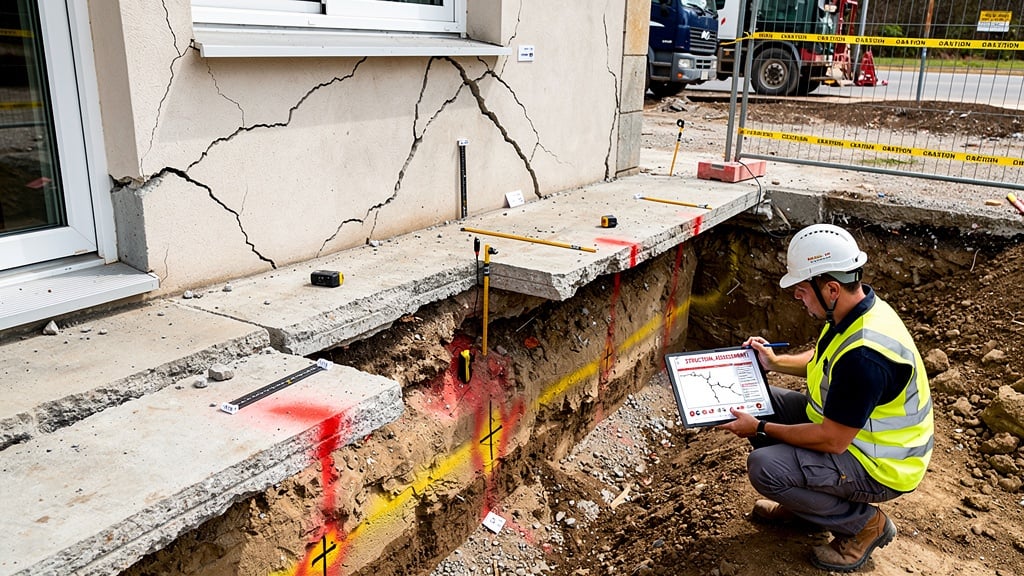
Subsidence is one of the most serious and feared structural problems that can affect residential properties, yet it's often misunderstood and frequently misdiagnosed. In London and North London particularly, subsidence concerns many property buyers and homeowners due to the prevalence of Victorian and Edwardian properties with shallow foundations, combined with London clay soil conditions and mature tree populations in leafy residential areas.
As building surveyors conducting hundreds of structural surveys across North London each year, we regularly investigate suspected subsidence and understand the anxiety it creates for property buyers and owners. This comprehensive guide explains what subsidence really is, what causes it in London properties, how to identify genuine subsidence (versus normal settlement or other structural movement), investigation processes, treatment options, costs, and insurance implications.
What Is Subsidence?
Subsidence is the downward movement of the ground beneath a building's foundations, causing the foundations to move downward and resulting in structural damage to the building above. It's important to distinguish subsidence from other types of structural movement:
Types of Structural Movement
- Subsidence: Downward movement caused by loss of support beneath foundations (soil shrinking, washing away, or compacting)
- Settlement: Downward movement as soil consolidates under the building's weight. Normal in new buildings; usually stops within 10 years and causes minor, superficial cracks
- Heave: Upward foundation movement when clay soil expands (often after trees are removed and soil rehydrates)
- Ground movement: Lateral movement of slopes or embankments
- Mining subsidence: Ground movement related to underground mining activities (historical in some London areas)
True subsidence involves progressive downward movement that continues over time, whereas settlement is a one-off consolidation that stabilizes. The distinction matters because subsidence requires investigation and often expensive remediation, while settlement typically requires only cosmetic repair once movement has stopped.
Causes of Subsidence in London Properties
Several factors make North London properties particularly susceptible to subsidence:
1. Clay Soil Conditions
Much of London is built on London Clay, a heavy shrinkable clay that undergoes significant volume changes depending on moisture content. During dry periods (particularly the increasingly common hot summers), clay soil shrinks as it loses moisture, causing the ground to compact and foundations to sink. During wet periods, clay soil expands as it absorbs water, potentially causing heave.
This cyclical shrink-swell behavior particularly affects Victorian and older properties with shallow foundations (typically only 2-3 feet deep, compared to modern foundations of 3-4 feet or more).
2. Tree Root Activity
Trees are the single most common cause of subsidence in London. Tree roots extract large amounts of moisture from clay soil (a mature oak can absorb up to 50,000 gallons per year), causing the soil to shrink and compact, particularly during dry summers.
High-risk tree species include:
- Oak: Very large water demand; roots can extend 1.5-2 times the tree's height
- Poplar: Extremely high water demand and fast-growing; roots can reach 30+ meters
- Willow: High water demand; roots actively seek water sources
- Elm: Large root spread and high water demand
- Ash: Deep roots and significant water extraction
- Plane: Common London street tree with extensive root systems
- Cherry/Plum: Moderate risk but common in gardens
Trees don't need to be touching the property to cause subsidence. As a general rule, high-risk trees should be at least their mature height away from buildings on clay soil. For a 20-meter oak, that means 20+ meters distance is advisable.
Leafy areas of North London like Muswell Hill, Highgate, Hampstead, and parts of Barnet, Enfield, and Haringey have extensive mature trees and correspondingly higher subsidence risk.
3. Leaking Drains
Defective drains wash away soil beneath foundations, creating voids that cause foundations to sink. Victorian drainage systems, often over 100 years old, commonly develop cracks, fractures, and joint failures allowing water to escape and erode supporting ground.
Drain-related subsidence typically causes rapid, localized damage near the affected drain run, whereas tree-related subsidence develops more gradually over several seasons.
4. Shallow Foundations
Victorian properties (built 1837-1901) typically have foundations only 2-3 feet deep—insufficient to reach stable soil below the zone affected by seasonal moisture changes. Modern Building Regulations require foundations at least 3 feet deep, and preferably 3.3 feet (1 meter) in clay soil areas.
5. Historic Mining Activity
Parts of North London have historical coal mining, chalk extraction, or clay pit activity that can cause ground instability decades or even centuries after mining ceased. Areas with known mining history include parts of Barnet, Enfield, and Haringey.
Identifying Subsidence: Warning Signs
Not all cracks indicate subsidence, and subsidence doesn't always cause dramatic cracking. However, certain warning signs warrant professional investigation:
Crack Characteristics That Suggest Subsidence
Serious warning signs include:
- Crack width: Cracks wider than 5mm (about the width of a pound coin) require investigation; cracks over 15mm indicate severe movement
- Crack pattern: Diagonal cracks running from the base of the building upward at approximately 45 degrees, especially near windows and doors
- Stepped cracking: Cracks following the mortar joints in a stair-step pattern
- Location: Cracks appearing on outside walls, particularly on corners or where extensions meet the main building
- Progressive widening: Cracks that visibly widen over time (monitored via crack gauges or marker studs)
- Door and window problems: Doors and windows that stick, won't close properly, or show gaps in frames
- Visible tilting or leaning: Walls or chimney stacks that visibly lean or aren't plumb
- Rippling in brickwork: Wavy or rippling appearance in previously flat walls
Cracks That Are Usually NOT Subsidence
Many cracks are not subsidence-related and don't indicate serious problems:
- Fine hairline cracks: Under 1mm wide, typically caused by plaster shrinkage or thermal movement
- Vertical cracks: Straight vertical cracks, particularly at wall junctions, often caused by thermal expansion/contraction
- Cracks in new extensions: Settlement cracks in extensions under 10 years old (normal settlement as soil consolidates)
- Pattern cracking: Network of fine cracks across ceiling or wall surfaces (plaster failure, not structural)
- Cracks that open and close seasonally: Thermal movement cracks that widen in summer and close in winter (normal)
Investigating Suspected Subsidence
If subsidence is suspected, a structured investigation process is essential to determine the cause, extent, and appropriate remediation:
Stage 1: Initial Building Survey Assessment
A RICS Level 3 Building Survey provides the initial assessment, including:
- Detailed recording of crack patterns, widths, and locations
- Assessment of whether movement appears progressive or historical
- Identification of likely causes (trees, drains, soil conditions)
- Recommendations for further specialist investigation if required
- Initial repair cost estimates
Stage 2: Crack Monitoring
If movement appears recent or ongoing, crack monitoring is essential. This typically involves:
- Tell-tales or crack markers: Simple devices placed across cracks to show any widening
- Digital monitoring: More sophisticated systems measuring movement to 0.01mm accuracy
- Monitoring duration: Typically 12 months minimum (ideally 2-3 years) to capture seasonal variations
- Cost: £200-£500 for installation and interpretation
Monitoring determines whether movement is ongoing (requiring intervention) or historical/stable (requiring only repair of existing cracks).
Stage 3: Structural Engineer's Report
A structural engineer provides detailed analysis including:
- Site investigation including trial pits or boreholes to examine soil and foundations
- Assessment of foundation depth and construction
- Tree survey identifying species, size, proximity, and root activity
- Detailed structural calculations
- Specific recommendations for remediation
- Cost: £1,000-£3,000 depending on complexity
Stage 4: Drain Testing (CCTV Survey)
If drain leaks are suspected, CCTV drain surveys identify defects without excavation:
- Camera inspection of all accessible drainage
- Identification of cracks, root intrusion, collapsed pipes
- Assessment of required repairs
- Cost: £200-£600 depending on drainage complexity
Subsidence Repair Solutions and Costs
Minor Remediation (Non-Structural)
If monitoring shows movement has stopped or is minor, repairs may be limited to:
- Crack filling and redecoration (£500-£2,000)
- Minor structural repairs (stitching cracks with helical bars: £2,000-£5,000)
Tree Management
If trees are the cause, options include:
- Tree removal: Complete removal of offending tree (£500-£3,000 depending on size). However, this can cause heave as soil rehydrates.
- Crown reduction/pollarding: Reducing tree canopy by 30-50% to reduce water demand (£400-£1,500)
- Root barriers: Installing barriers to limit root spread toward foundations (£2,000-£8,000)
Important: Tree work requires careful consideration. Removing large trees can cause heave (upward ground movement) as soil rehydrates, potentially causing as much damage as the original subsidence. Professional arboricultural advice is essential.
Drain Repairs
If drain defects are causing subsidence:
- Patch repairs to isolated defects (£500-£1,500)
- Drain lining with resin liners (£1,500-£4,000)
- Complete drain replacement (£3,000-£10,000+)
Underpinning
For serious subsidence with ongoing movement, underpinning strengthens foundations by extending them to deeper, more stable soil:
Traditional mass concrete underpinning:
- Excavating sections beneath existing foundations
- Filling with mass concrete to extend foundations deeper
- Very disruptive but effective and proven
- Cost: £10,000-£50,000 depending on extent and access (typically £1,000-£2,000 per linear meter)
Piling systems:
- Mini-piles driven deep beneath existing foundations
- Concrete beams connect piles to transfer building load
- Less disruptive than mass concrete underpinning
- Cost: £15,000-£60,000 depending on depth and number of piles required
Resin injection:
- Expanding resin injected beneath foundations to stabilize and lift
- Minimal disruption; can be completed in days rather than weeks
- Suitable for some subsidence types but not universally appropriate
- Cost: £5,000-£25,000
Insurance and Subsidence
Making a Subsidence Claim
Most buildings insurance policies cover subsidence (check your specific policy). If you discover subsidence, inform your insurer immediately. The typical claim process involves:
- Initial assessment: Insurer's surveyor inspects and assesses severity
- Monitoring period: 12+ months of monitoring to confirm ongoing movement
- Investigation: Structural engineer's report, drain testing, tree surveys
- Remediation: Insurer funds appropriate repairs (subject to policy excess, typically £1,000-£2,500)
Impact on Property Value and Future Insurance
Subsidence affects property values and insurability:
- During active subsidence: Property is difficult to sell and mortgage; values drop significantly (20-50% reductions possible)
- After repair with monitoring showing stability: Values typically recover to 5-15% below similar properties without history
- Insurance: Properties with subsidence history face higher premiums (£500-£2,000 additional annually) and larger excesses (£2,500-£5,000 for future subsidence claims)
- Disclosure: Subsidence history must be disclosed when selling (non-disclosure can result in legal action by buyers)
Preventing Subsidence
While you can't eliminate subsidence risk, several measures reduce it:
Tree Management
- Avoid planting high-risk tree species near properties on clay soil
- Maintain existing trees with regular crown reduction to limit water demand
- Consider root barriers if planting large trees within 20 meters of buildings
- Don't remove large established trees suddenly (heave risk); reduce gradually over several years
Drainage Maintenance
- CCTV survey drains every 10-15 years, particularly in properties over 50 years old
- Repair any defects identified promptly
- Clear tree roots from drains
- Ensure surface water drains away from building foundations
Regular Monitoring
- Check for new cracks annually, particularly after hot, dry summers
- Monitor existing cracks to see if they're widening
- Photograph cracks with a ruler in view for future comparison
- Seek professional advice if cracks widen or new significant cracks appear
Frequently Asked Questions
How can I tell if my property has subsidence or just normal settlement?
Settlement cracks are typically fine (under 3mm), vertical, and stabilize within 10 years of construction. Subsidence cracks are usually wider (5mm+), diagonal, run from ground level upward at approximately 45 degrees, and progressively worsen over time, particularly after dry summers. Subsidence also causes doors/windows to stick and may show seasonal variation (worse in summer/autumn, improving in winter). Professional monitoring over 12+ months can definitively distinguish ongoing subsidence from historic settlement.
How much does subsidence repair typically cost?
Costs vary enormously depending on severity. Minor repairs (crack filling and redecoration) cost £500-£2,000. Tree management ranges from £400-£3,000. Drain repairs cost £500-£10,000 depending on extent. Traditional mass concrete underpinning typically costs £10,000-£50,000 (£1,000-£2,000 per linear meter), while piling systems range from £15,000-£60,000. Most buildings insurance policies cover subsidence repair costs (minus your policy excess, typically £1,000-£2,500), though you'll face higher premiums afterward.
Will removing the tree causing subsidence solve the problem?
Not necessarily, and it can create new problems. Removing a large tree that's been extracting moisture from clay soil can cause heave (upward ground movement) as the soil rehydrates, potentially causing as much damage as the original subsidence. Better options are often crown reduction (reducing the canopy by 30-50%) to decrease water demand while leaving the tree in place, or installing root barriers. Always seek professional arboricultural and structural engineering advice before removing trees related to subsidence.
Does subsidence always require underpinning?
No, definitely not. Many subsidence cases can be resolved without underpinning. If the cause is identified and removed (e.g., repairing leaking drains, managing tree growth, improving drainage), movement often stops and only superficial crack repairs are needed. Monitoring may show that movement was historic and has already stabilized, again requiring only cosmetic repair. Underpinning is typically only necessary when monitoring confirms ongoing progressive movement that cannot be stopped by addressing the underlying cause, or when movement has been so severe that structural strengthening is required even after movement stops.
Take the Next Step
Subsidence is serious but not always catastrophic. Many London properties with shallow foundations and nearby trees never experience subsidence, while proper investigation and repair can successfully resolve most cases that do occur.
The key is early identification, accurate diagnosis, and appropriate remediation based on professional structural engineering advice. Don't panic if you discover cracks—most cracks are not subsidence—but do seek professional assessment if warning signs are present.
When buying a property in North London, particularly Victorian and Edwardian properties in leafy areas, invest in a comprehensive RICS Level 3 Building Survey to identify any existing or potential subsidence issues before you commit to purchase. This allows you to make informed decisions, negotiate purchase prices fairly, and plan for any necessary remediation work.